
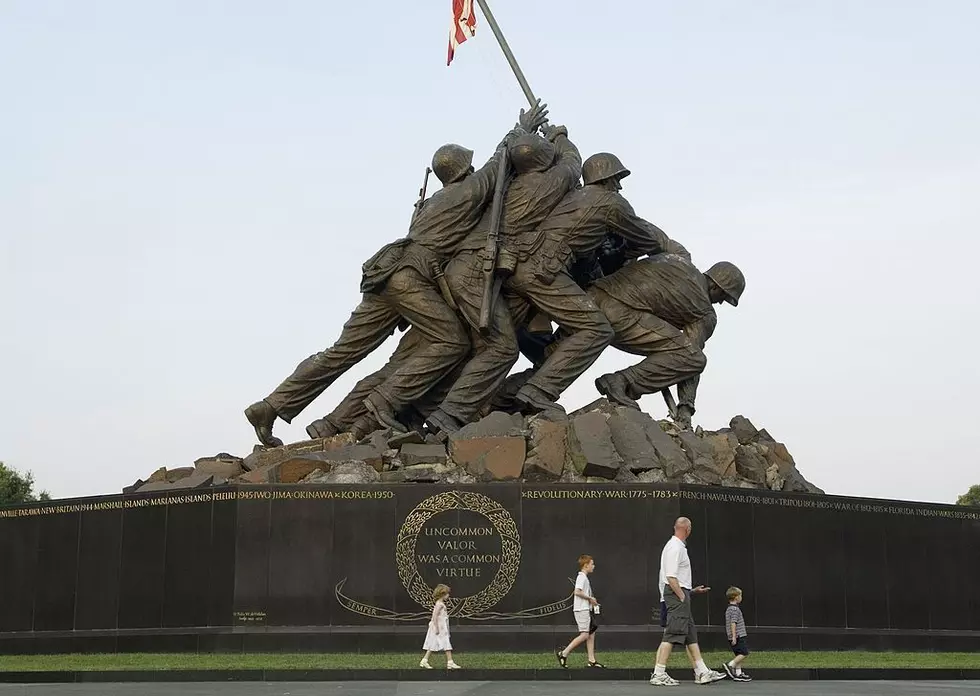
Attack On Iwo Jima Memorial Decapitates Texas-Born Flag-Raiser Harlon Block
The World War Two hero depicted in the Iwo Jima monument who was decapitated by an illegal immigrant, is a Texan.
Extensive Damage to World War II Sculpture
The attack targeted the iconic limestone depiction of six servicemen raising the American flag during the 1945 Battle of Iwo Jima. The severe blunt force impact severed the head of the figure depicting Texas native Marine Cpl. Harlon Block, the Marine positioned at the very base of the flagstaff in Joe Rosenthal’s iconic 1945 photograph. The attack left behind destruction estimated in the hundreds of thousands of dollars.
The Legacy of Harlon Block
Harlon Henry Block was a United States Marine Corps corporal whose brief life became permanently interwoven with one of the most famous photographic moments in American military history. Born in Yorktown, Texas, Block joined the Marine Corps in early 1943 alongside seven of his high school classmates from Weslaco. He saw his first intense combat in the South Pacific on Bougainville before his specialized unit was disbanded in 1944.
The Battle of Iwo Jima and the Dual Flag-Raisings
On February 19, 1945, Cpl. Block landed on the southern beaches of Iwo Jima near the base of Mount Suribachi. His regiment's primary objective was to assault and secure the heavily fortified volcanic peak overlooking the island.
The Initial Flag-Raising
On the morning of February 23, a 40-man patrol scaled the 556-foot volcano, engaged enemy forces, and secured the crest. At approximately 10:30 a.m., Marines raised a standard-issue American flag attached to a steel pipe.
The Second Flag-Raising
After realizing the original flag was too small to be seen across the broader battlefield, commanders ordered a larger replacement taken up the mountain. Cpl. Block, alongside squad leader Sgt. Michael Strank, Pfc. Ira Hayes, and Pfc. Franklin Sousley, carried supplies and communication wire to the summit.
The Moment Captured
Around 1:00 p.m., as the first flag was taken down, six service members drove a heavy steel pipe bearing the larger flag into the volcanic soil. Associated Press photographer Joe Rosenthal captured the scene in a timeless black-and-white photograph, while Marine Sergeant Bill Genaust recorded the action on color motion picture film.
Tragic Death
Shortly after the historic flag-raising, Cpl. Block assumed leadership of his rifle squad following the death of Sgt. Strank on March 1, 1945. Later that same day, Block was mortally wounded by an enemy mortar shell during an assault toward Nishi Ridge.
Ultimate Resting Place
Initially buried in the military cemetery on Iwo Jima, Block's remains were repatriated to Texas in 1949 and re-interred in Weslaco. Decades later, in 1995, his body was moved to its final resting place on the grounds of the Marine Military Academy near the Iwo Jima Monument in Harlingen, Texas.
The Memorial
The monument was sculpted by Felix de Weldon in 1954 and is located near Marine Corps Base Quantico, about 36 miles south of Washington, D.C. The monument honors all U.S. Marines who have lost their lives in service since 1775.
Suspect Identified in Sledgehammer Vandalism of Quantico Iwo Jima Memorial
According to the New York Post, 27-year-old Miguel Alonso Maldonado Soriano is charged with using a sledgehammer to decapitate part of the historic Iwo Jima monument outside Marine Corps Base Quantico. Soriano is an illegal immigrant who entered the United States during the Obama Administration.
LOOK: This is an Amazing Historical World War II Hangar Hotel and Museum
Gallery Credit: Rudy Fernandez
FOUND! Wreckage from World War 2 Cargo Plane in the Adirondacks
Gallery Credit: Architectural Orphans/YouTube